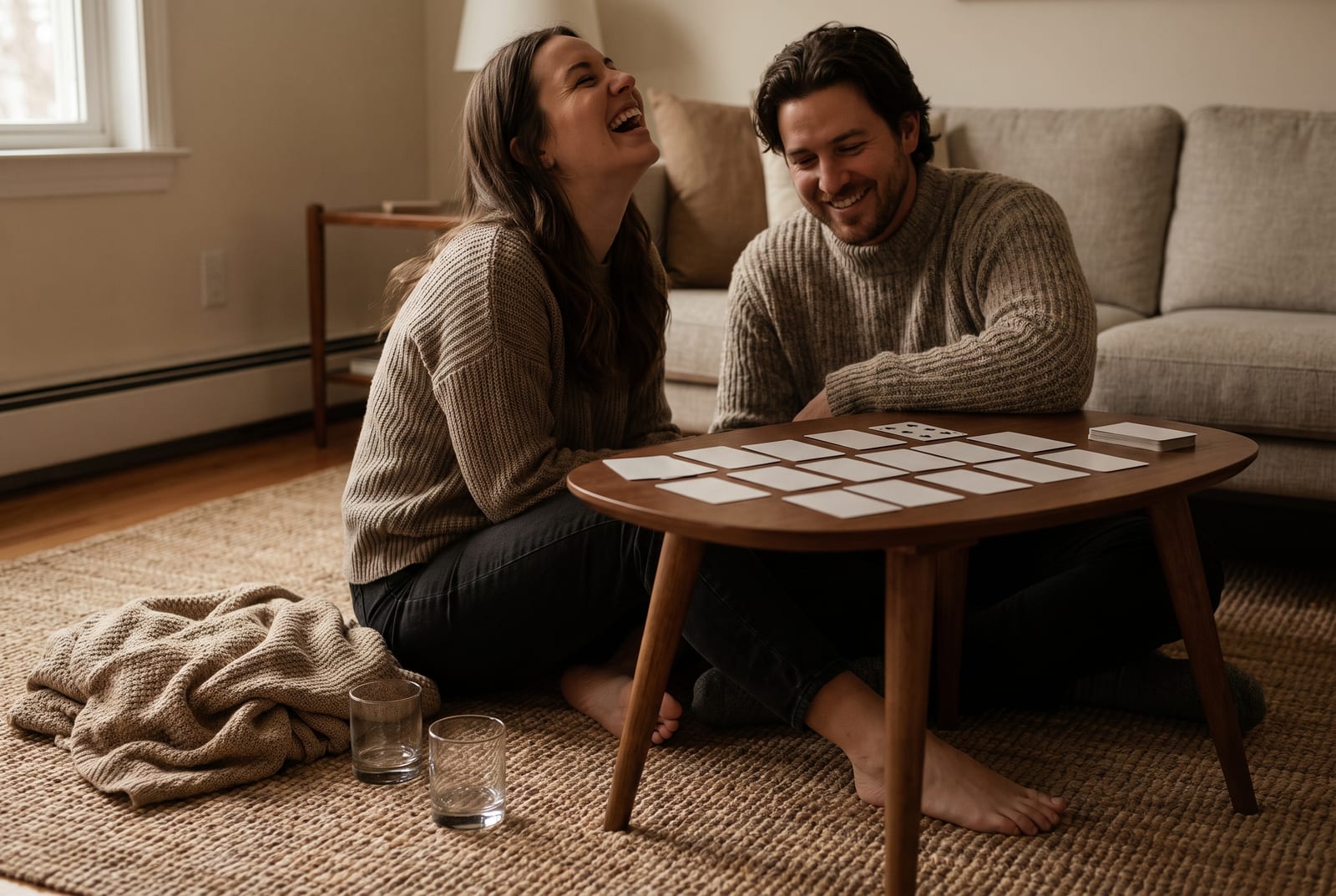
Almost every list of strip games is written for a party, then quietly handed to couples who are two people on a sofa. That is why so many of them fall apart on contact: a card czar needs three players, beer pong needs teams, and a game where the loser picks someone else to strip has nowhere to point when there is only one other person in the room. These seven are different. Each one works at exactly two, each runs on one ordinary deck, and the rules below are the two-player rules, not the group rules with the extra players crossed out.
Want to play instead of read? These strip games for couples run right in your browser, and the game keeps track of who has taken off what.
What changes when there are only two of you
Three things, and they all pull in the same direction. The first is pace: with two players every single hand costs somebody something, where in a group of six you can sit out four rounds in a row fully dressed. A two-player strip game moves about three times faster than the same game with a crowd, which is why the starting count matters more than the rules do.
The second is that there is no hiding. In a group, the person having a bad run is one of several. With two, a losing streak is very visible, and the game gets lopsided fast. Every set of rules below has a small balancing tweak for that, usually a way for the player who is behind to claw one back.
The third is the good part. With two people you can change a rule mid-game just by saying so. If a game is running too fast, add an item each and carry on.
Three things to agree on before you deal
- The count. Say the number out loud and make it equal. Six to eight items each is the range that gives a game a beginning, a middle and an end. Socks count as two, or as one, or not at all, but decide which before the first hand rather than during an argument about it.
- The edges. One sentence each about anything that is off the table tonight. It takes ten seconds and it is the difference between a game that stays fun and one that stalls at the exact moment you would rather it did not.
- The ending. What happens when someone runs out. Pick one of the two options in the FAQ below and say it now, while it is a rule and not a decision about a person who is sitting there with nothing left to take off.
1. Heads-up five-card draw
Poker is the obvious one and it is obvious for a good reason: heads-up is a real format, not an adaptation. Deal five cards each, one round of betting where the currency is clothing, then each of you discards up to three and draws replacements, then a second round. Best hand takes it, the loser pays one item.
The two-player tweak worth adding: the winner of a hand deals the next one. It sounds trivial and it is not, because the dealer acts second in the betting and that small edge tends to hand the run back to whoever is behind.
2. Strip blackjack, swapping the deal
One of you deals, the other plays, and you swap after every hand so the house edge cancels out over the night. Standard rules: closest to 21 without going over, dealer draws to 16 and stands on 17. Bust and you pay an item. Beat the dealer and they pay.
Hitting exactly 21 is worth making special. Two items instead of one, or the winner picks which item goes, is enough of a jackpot to make the whole table lean in when someone is sitting on nineteen and thinking about it.
3. Strip war, the one that needs no skill
Split the deck in half, each of you flips the top card, high card wins, loser pays. That is the entire game. It exists on this list because it is the only one where being good at cards is worth nothing, which makes it the right opener if one of you plays cards and the other has not since school.
When both cards match you get a war: three cards face down each, then a fourth face up, and the winner of that takes everything and the loser pays two items instead of one. War is pure chance and takes about twelve minutes, which is roughly how long a first game should last.
4. Strip gin rummy
Ten cards each, draw and discard, and you are trying to arrange your hand into sets and runs. Knock when your unmatched cards total ten points or fewer. The player with the higher deadwood count pays, and here is the version that works best for two: the size of the loss decides the forfeit. Under ten points behind and it is one item, over twenty and it is two.
Gin rummy is slower than everything above it, which is a feature on a long evening. It is the game to reach for when you want something that lasts more than one drink.
5. Strip speed, for a game that lasts four minutes
Both players play at once, no turns, racing to empty a hand onto two central piles by playing cards one rank above or below the top card. First to run out wins the round, the other pays. It is loud, it is physical, and hands collide over the table, which is most of the appeal.
Because a round takes under two minutes, play it in best-of-five blocks and pay one item per block rather than per round. Otherwise a fast player empties a wardrobe in ten minutes and the evening is over before it started.
6. Two-handed UNO
The only game here that needs a box rather than a deck, and the only one whose rules genuinely change at two players. Reverse acts as a Skip, which means it hands you another turn instead of changing direction. Draw Two and Wild Draw Four hit the only other person at the table, so they are far more brutal than in a group.
Keep it simple: whoever goes out first wins the round, the other pays one item, and forgetting to say the last card out loud costs one on the spot. Do not use the version where drawing any card means stripping, because in a two-player game the draw pile does a lot of work and that rule ends things almost immediately.
7. Strip cribbage, the one nobody lists
Cribbage is the great two-player card game and it is missing from every strip-games roundup we could find, which is a shame because it is the best fit of the lot. Six cards each, discard two into the crib, peg your way to 121. Play it as a race: every time one of you crosses a street of thirty points before the other does, they win an item.
It rewards playing well without punishing a beginner, because the crib alternates and the pegging gives the trailing player chances to the end. If neither of you knows cribbage, start at number three and come back.
When the cards run out, and what to do instead of stopping
The honest limit of every game on this page is that clothing is finite, and the good part of the evening usually starts somewhere around the point the game technically ends. That is where a forfeit that is not an item comes in: a task, a wish, something one of you names. If you would rather not invent those on the spot, our strip game forfeit ideas is a list to steal from, and the wider strip games guide for couples covers the formats beyond cards.
If you want the same lose-and-pay engine without shuffling anything, strip checkers runs it on a board you both already know, and Truth or Dare does the talk-and-task version. For a whole evening built around this rather than one game, the couples game night planning guide is the place to start, and you can always browse every couples' game instead. In December, winter layers make the longest strip rounds of the year, and our Christmas sex games build a whole holiday night around them.
Frequently asked questions
Heads-up five-card draw is the classic, because two players is the count poker was built for. Beyond that, strip blackjack, war, gin rummy, speed, two-handed UNO and cribbage all work with exactly two. Cribbage is the one most lists miss, and it is the only game here designed from the start as a two-player game rather than adapted down from a group.
Count them out loud before the first deal and make the numbers equal. Six to eight items each is the range that keeps a game interesting: fewer than five and the whole thing is over in ten minutes, more than ten and the middle drags. Jewellery, watches and hair ties count only if you both agree they do, and it is easier to say so before anyone is losing.
No. Every game on this page except UNO runs on one ordinary 52-card deck. That is the point of playing cards rather than buying a themed box: the rules live in your head, the deck costs nothing, and you can change the forfeit mid-game without anyone reprinting a card.
Decide this before you start, because it is the moment the game either ends well or ends awkwardly. Two options work. Either that player has lost and the game stops there, or they keep playing and each further loss becomes a task instead of an item, which is how our games handle it. What nobody should do is the rule some guides suggest, where the undressed player is forbidden to cover up. Anyone can stop at any point.
Strip war and heads-up poker are the two to start with. War needs no skill at all, so there is no gap between a card player and someone who has not held a hand in years, and poker is familiar enough that nobody has to read rules aloud. Save cribbage and gin rummy for a night when you both want the game itself to be good, not just the forfeits.
Seven games, one deck, and a count you agree on before the first hand. Start with war if you want the cards to decide everything, poker if you want to bluff, and cribbage on the night you want the game to be genuinely good on its own terms. The rules are yours to bend the moment they stop being fun, which is the one real advantage of playing anything with exactly two people.