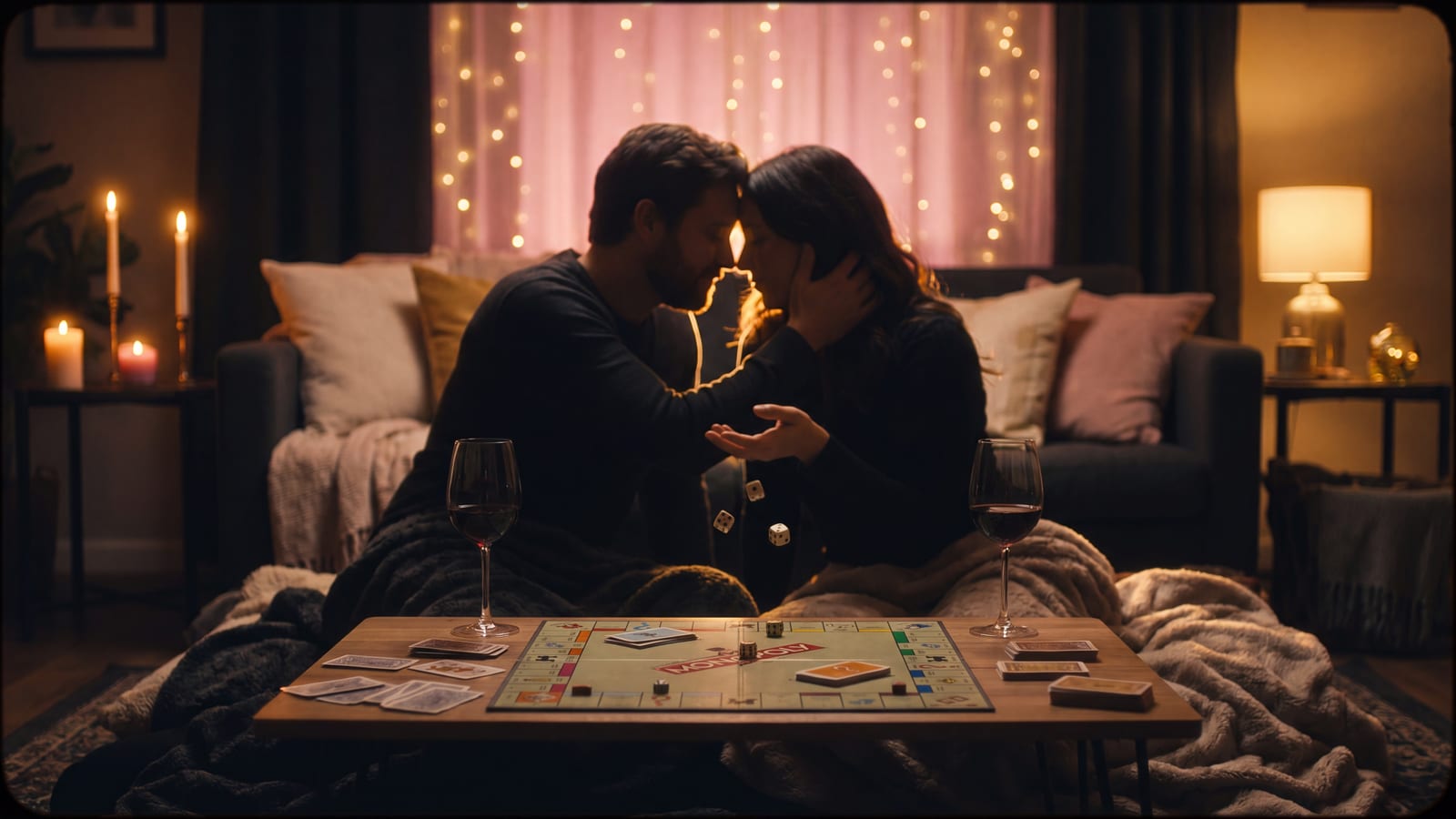
Couples Game Night: The Ultimate Planning Guide — 7 Games to Transform Your Evenings
There is a reason relationship therapists consistently recommend one specific activity above almost all others: play together. Not expensive vacations. Not elaborate date nights at restaurants where you stare at your phones between courses. Not even couples therapy itself (though that has its place). The single most effective tool for reconnecting with your partner is structured, intentional play.
And the best vehicle for that? A couples game night.
But here is the catch. Most couples who try game night do it wrong. They grab a dusty board game off a shelf, halfheartedly play for twenty minutes, get bored, and conclude that "game nights aren't for us." That is like trying to run a marathon after a single jog around the block and deciding running is overrated.
This guide is different. Over the next fourteen minutes, you are going to learn the actual science behind why play transforms adult relationships, how to create the perfect atmosphere for a game night that both of you will look forward to, and which seven games are specifically designed to deepen intimacy, spark desire, and break the patterns that make long-term relationships feel stale.
The Science Behind Play in Adult Relationships
When researchers at the National Institute for Play studied adult couples who regularly engage in structured play, they found something remarkable: couples who play together report 67% higher relationship satisfaction than those who rely on passive activities like watching television side by side.
Why? It comes down to neurochemistry.
During play, your brain releases a cocktail of chemicals that essentially recreates the early-relationship feeling most couples desperately miss:
- Dopamine surges during moments of anticipation and surprise. Rolling a die, drawing a card, not knowing what comes next — these micro-moments of uncertainty trigger the same reward pathways that fired when you first started dating and everything felt electric.
- Oxytocin increases during physical touch, eye contact, and vulnerable self-disclosure — all of which are built into well-designed couples games.
- Endorphins release through laughter. Couples who laugh together during play report feeling closer for up to 48 hours afterward.
- Norepinephrine activates during mildly challenging or exciting activities, heightening focus and making your partner the center of your attention rather than a background fixture.
Dr. Stuart Brown, founder of the National Institute for Play, puts it bluntly: "The opposite of play isn't work. It's depression." For couples trapped in routines of work-dinner-screen-sleep, introducing structured play is not frivolous. It is therapeutic.
There is another layer researchers have identified: shared novel experiences literally rewire how your brain perceives your partner. Psychologist Arthur Aron's research at Stony Brook University demonstrated that couples who engage in novel, arousing activities together experience increased relationship quality — and crucially, their brains showed reactivation of the same neural pathways active during early romantic love.
A couples game night is the simplest, most accessible way to generate these novel experiences without leaving your living room.
Curious which intimate game style fits your relationship? Take a quick quiz to find out.
Explore Our Quizzes →How to Set Up the Perfect Game Night
Before we get into the games themselves, let us talk about the container. The atmosphere you create around your game night matters almost as much as the games you choose. Here is how to set it up so both of you actually want to do it again.
Timing: When to Play
The single biggest mistake couples make is trying to squeeze game night into an already-exhausted evening. If you are both drained from work, kids, and chores, starting a game at 10:30 PM is a recipe for resentment.
The Golden Rules of Timing
- Pick a consistent night. Regularity matters more than frequency. Every other Friday works better than random "we should play tonight" suggestions.
- Start earlier than you think. 8:00 PM is better than 10:00 PM. You want energy, not obligation.
- Block 60-90 minutes. Most couples games take 20-45 minutes, but you want buffer time for conversation, laughter, and whatever the games inspire.
- Phones go away. Not on silent. Not face-down on the table. In another room. This is non-negotiable.
Atmosphere: Setting the Scene
You do not need to transform your apartment into a five-star lounge. But small intentional touches signal to both your brains: this is different from a regular evening.
- Lighting: Dim the overhead lights. Use candles or warm-toned lamps. Harsh fluorescent lighting kills intimacy faster than an argument about dishes.
- Sound: Put on a low-volume playlist. Instrumental music works best — lyrics can compete for attention. Lo-fi, jazz, or ambient electronic are all solid choices.
- Drinks: Have something special ready. It does not have to be alcohol (though a glass of wine can help with initial awkwardness). A nice tea, craft mocktail, or even just sparkling water with fruit makes the evening feel curated.
- Space: Sit close. On the couch together, on the floor with cushions, or at a small table where your knees touch. Physical proximity matters.
Ground Rules: The Agreements That Make It Work
Before your first game night, have a brief five-minute conversation about boundaries. This is not clinical — it is caring. Here is what to cover:
- The skip rule. Either person can skip any question or dare without explanation or judgment. Always. No exceptions.
- No scorekeeping outside the game. Something your partner reveals during Truth or Dare does not become ammunition in a future argument.
- Enthusiasm over obligation. If one of you genuinely is not feeling it on a particular night, reschedule without guilt. Forced play defeats the purpose.
- Debrief afterward. Spend five minutes talking about what you enjoyed. This positive reinforcement makes you both want to do it again.
The 7 Games That Transform Your Evenings
Now for the main event. These seven games are specifically designed for couples and range from emotionally deep to playfully provocative. Each one targets different aspects of your relationship, and we will tell you exactly when to use each.
1. Truth or Dare — The Classic Reinvented
You played it as a teenager at sleepovers, but the adult couples version is an entirely different experience. LovePlay's Truth or Dare is designed with graduated intensity levels and questions crafted by relationship psychologists to facilitate genuine vulnerability — not just shock value.
How it works: Choose "Truth" to answer a deep, thought-provoking question about your desires, fantasies, or relationship, or choose "Dare" to complete a physical or emotional challenge with your partner. The intensity adapts based on your comfort level.
Best for: Your very first game night. It is familiar enough to feel safe, structured enough to push boundaries, and flexible enough to adapt to any mood. Couples who want equal parts emotional depth and physical spontaneity will find it hits the sweet spot.
Why it works: Truths activate the brain's vulnerability circuits — the same pathways that create emotional bonding during deep late-night conversations. Dares activate reward and excitement centers. The choice between them gives you agency, which reduces anxiety and increases willingness to participate.
Sample truth: "What is one thing you have always wanted to ask me in bed but never had the courage to?"
Sample dare: "Blindfold your partner. Using only your fingertips, trace a message on their back. They have to guess what you wrote."
Pro tip: Start at the lightest intensity level, even if you think you are both comfortable. Warming up slowly makes the bolder cards feel natural rather than jarring.
Truth or Dare is the best starting point for your first couples game night. Try it free tonight.
Play Truth or Dare Now →2. Sexopoly — The Strategic Board Game
If Truth or Dare is the gateway, Sexopoly is the deep dive. Modeled on classic board game mechanics, it takes you on a 40-cell journey of escalating intimacy. You roll dice, move your piece, and complete whatever challenge the board assigns. Simple mechanics, profound impact.
How it works: A digital board with 40 cells, each containing a unique task, question, or challenge. Tasks start gentle (compliments, light touches) and build naturally toward more intimate territory as you progress around the board. A typical session runs 45-90 minutes.
Best for: Couples who thrive on structure and progression. If you like the idea of a predictable time commitment with unpredictable content, Sexopoly delivers. It is especially effective for couples who want to build a recurring ritual — "Sexopoly Saturdays" has a certain ring to it.
Why it works: The gradual escalation mirrors the natural arc of arousal and intimacy. Your brain gets comfortable with lower-intensity tasks first, which primes it to embrace bolder ones later. The dice-rolling mechanic creates micro-anticipation before each turn — a small dopamine hit that keeps you engaged and curious.
What makes it special: Sexopoly has the highest replay rate of any couples game format. 78% of couples who play it once play again within two weeks. The structure removes decision fatigue — you do not have to think of something romantic or creative. The game does the work. You just show up and be present.
Ready for a full evening of structured intimacy? Sexopoly is the most popular game on LovePlay.
Start Sexopoly →3. Sexy Slots — The Spontaneity Engine
Sometimes you do not want a 90-minute structured experience. Sometimes you want a five-minute shot of adrenaline that takes your evening in an unexpected direction. That is exactly what Sexy Slots delivers.
How it works: Spin a slot machine-style interface and get a randomly generated intimate task. Pure chance, instant results. No strategy, no planning, no thinking. Just spin and do.
Best for: Spontaneous couples. Busy couples who only have fifteen minutes. Couples who are already mid-evening and want a quick spark. It is also the perfect "warm-up" before a longer game — one or two spins can set the tone for the rest of the night.
Why it works: Unpredictability is the fastest route to dopamine. When your brain cannot predict what comes next, it floods your system with attention and excitement chemicals. The low-commitment format ("just one spin") lowers the psychological barrier to starting, which is often the hardest part of any couples activity.
Sample spin result: "Whisper your wildest fantasy into your partner's ear. They have 30 seconds to act out the first step."
Tip: Use Sexy Slots as a "pattern interrupter" during the week. Mid-Wednesday, after the kids are in bed, do a single spin. It takes two minutes and creates anticipation for the weekend.
4. Hot & Cold — The Body Exploration Game
This is the game that teaches you things about your partner's body you did not know after years together. It sounds like a bold claim, but couples consistently report discovering new sensitive spots and preferences they never thought to communicate before.
How it works: One partner reads a secret instruction on a card — something like "Kiss your partner's inner wrist five times." Then the card flips to show only a partial version: "Kiss your partner's _____ five times." Your partner does not know the hidden word. They start exploring, and you guide them with temperature cues: "cold," "warmer," "hot!" The result is a playful, communicative treasure hunt across each other's bodies.
Best for: Couples who want to improve physical communication without the awkwardness of a clinical conversation. If you or your partner struggle to say "I like it when you touch me here," Hot & Cold lets the game do the talking. Sessions typically run 15-30 minutes.
Why it works: It activates three powerful mechanisms simultaneously. First, the mystery element creates anticipation and dopamine. Second, the verbal guidance requires active, real-time communication — a skill that transfers directly to better intimacy outside the game. Third, the exploratory touch with partner-led direction helps both people learn each other's responses in a low-pressure, playful context.
User insight: "We have been married eleven years and I thought I knew everything about what he likes. Hot & Cold proved me wrong in the best possible way. The guiding part had us laughing and then suddenly it was very much not a laughing matter anymore."
Discover what you never knew about each other — even after years together.
Play Hot & Cold →5. Drink or Dare — The Lighthearted Icebreaker
Not every game night needs to be deeply intimate from the first minute. Sometimes the best path to connection runs through laughter, silliness, and a well-timed cocktail. Drink or Dare is designed for exactly those evenings.
How it works: Draw a card with a dare on it. You have two choices: complete the dare or take a drink. The dares range from playful and silly to flirtatious and bold, escalating naturally as the game progresses.
Best for: Date nights with drinks. Couples who need to decompress and laugh before they can open up emotionally. Partners where one person is naturally more reserved — the choice mechanic means nobody feels forced. Ideal for Friday nights when you want to transition from "work mode" to "us mode" over 20-40 minutes.
Why it works: The dual-option structure is psychologically brilliant. Having the drink option reduces performance anxiety — even if you always choose the dare, knowing you could skip it makes each dare feel like a free choice rather than an obligation. Meanwhile, laughter is one of the most underrated bonding mechanisms in relationships. Endorphins released through genuine laughter create the same neurological bonding patterns as physical intimacy.
Important note: Drink or Dare works best with light, moderate drinking. One to two glasses of wine or a couple of cocktails lowers inhibitions just enough to encourage playfulness. Heavy drinking actually reduces both emotional connection quality and physical responsiveness. Keep it fun, not sloppy.
6. Role Play — The Fantasy Laboratory
Role play is the most polarizing game on this list. Some couples absolutely love it from the first scenario. Others feel self-conscious and awkward. Both reactions are completely valid, and here is the key: the awkwardness usually disappears by the second or third session if you start with the right scenario.
How it works: Choose from curated scenarios complete with character prompts, dialogue starters, setting suggestions, and escalation paths. Each scenario is designed so you can ease into the characters gradually rather than jumping straight into full performance mode.
Best for: Adventurous couples who have already established comfort with lighter games and want to explore fantasies together. Also excellent for couples who find themselves stuck in rigid roles in real life — playing a different character can unlock aspects of yourself and your partner you have never seen.
Why it works: Playing a character creates what psychologists call "identity distance." When you are "the mysterious stranger" or "the massage therapist," your inhibitions drop because you are not fully "you" in that moment. This allows exploration of desires and dynamics that might feel too vulnerable to approach directly. Your brain perceives each new scenario as an entirely new experience, triggering novelty-seeking reward pathways.
Starter tip: Begin with low-intensity scenarios like "spa therapist and client" or "photographer and model." These provide enough structure and roleplay to get comfortable without requiring extensive improvisation. Save the elaborate fantasies for once you have built confidence together.
Step into a new role and discover a side of your relationship you have never explored.
Try Role Play Scenarios →7. Scratch Card — The Quick Surprise
Scratch Card is the simplest game on this list, and sometimes simplicity is exactly what you need. Think of it as a digital scratch-off lottery ticket — except the prize is always an intimate experience with your partner.
How it works: You see a covered card on your screen. Scratch it to reveal a hidden intimate task. That is it. No rules, no turns, no strategy. Just scratch and discover.
Best for: Quick moments of spontaneity. Mid-week surprises. When you want something intimate but do not have the energy or time for a full game session. Also great as a warm-up before one of the longer games — scratch a card to set the opening mood.
Why it works: The physical act of "scratching" creates a sensory engagement that clicking a button does not. Combined with the reveal mechanic, it produces a concentrated burst of anticipation and surprise. It is the espresso shot of intimate games — small, fast, and surprisingly potent.
Creating Your Rotation Schedule: Which Games for Which Moods
One of the most effective strategies for maintaining a long-term game night habit is rotation. Playing the same game every time leads to diminishing returns, no matter how good the game is. Here is a practical framework for matching games to your mood and energy level.
The Mood-Based Game Selector
High energy + feeling adventurous:
Sexopoly (full session) or Role Play. These longer formats reward energy and willingness to explore.
Relaxed + wanting to connect emotionally:
Truth or Dare at medium intensity. The balance of truths and dares creates depth without demand.
Tired but wanting something together:
Sexy Slots (a few quick spins) or Scratch Card. Minimal effort, maximum impact per minute invested.
Playful + having drinks:
Drink or Dare. It is designed for exactly this mood. Let the laughter carry you.
Wanting physical connection:
Hot & Cold. It is the most directly physical game and guides you naturally toward touch-based intimacy.
Competitive + a little flirty:
Strip & Desire Checkers. The strategy keeps both of you engaged while every captured piece adds a playful forfeit, perfect for couples who like a bit of friendly rivalry.
Date night at home:
Start with Drink or Dare or Scratch Card as a warm-up (15 minutes), then transition to Sexopoly or Truth or Dare for the main event (45 minutes).
A Sample Monthly Rotation
If you commit to game night every other week — which is the minimum frequency researchers recommend for building lasting relationship habits — here is a balanced rotation:
- Week 1: Truth or Dare (ease in, build the habit)
- Week 3: Sexopoly (full immersive session)
- Week 5: Hot & Cold (shift focus to physical discovery)
- Week 7: Drink or Dare + Role Play (combo night: lighten up first, then go deeper)
Sprinkle Sexy Slots and Scratch Card throughout the week as spontaneous micro-moments. They do not require a dedicated evening — a single spin or scratch before bed keeps the playful energy alive between formal game nights.
5 Common Mistakes (And How to Avoid Them)
After observing patterns from thousands of couples, here are the most frequent game night pitfalls and their solutions.
Mistake 1: Starting Too Intense
The excitement of trying something new makes many couples jump straight to the most provocative content. This often triggers discomfort that poisons the experience.
Fix: Always start at the lowest intensity level, regardless of how adventurous you consider yourselves. You can escalate naturally. You cannot un-create an uncomfortable moment.
Mistake 2: Making It a Chore
If game night becomes another item on your to-do list between "clean bathroom" and "file taxes," it will not work. The moment it feels obligatory, the neurological benefits disappear.
Fix: Frame it as a treat, not a task. "I have been looking forward to tonight all week" is a fundamentally different energy than "We should probably do that game thing."
Mistake 3: Ignoring the Debrief
Most couples play, enjoy themselves, and then immediately move on to the next thing. They miss the most valuable part: talking about it afterward.
Fix: Spend five minutes after every session asking each other: "What surprised you?" and "What would you want more of next time?" This feedback loop accelerates both intimacy and game quality.
Mistake 4: One Partner Always Choosing
If the same person always picks the game and initiates the evening, the other partner becomes a passive participant. This creates an imbalanced dynamic that undermines the whole point.
Fix: Alternate who chooses the game each session. Or use a simple method: one person picks the game, the other sets the atmosphere. Shared ownership means shared enthusiasm.
Mistake 5: Quitting After One Awkward Session
The first session is almost always a little awkward. Nervous laughter, self-consciousness, uncertainty about how seriously to take it. This is normal. It is not a sign that game nights do not work for you.
Fix: Commit to three sessions before evaluating. The second session is typically when couples find their rhythm. By the third, it starts feeling natural and even anticipated.
Why Tonight Is the Right Night to Start
You have read the science. You know how to set the atmosphere. You understand which games match which moods. You even know the mistakes to avoid.
The only thing left is to actually do it.
Here is what we know from behavioral research: the likelihood of starting a new habit drops by 40% for every day you postpone past the moment of decision. You are at peak motivation right now. That energy has a half-life, and it is shorter than you think.
You do not need to plan the perfect evening. You do not need special supplies. You do not even need a full hour. Open Truth or Dare, set it to the lightest intensity, and play five rounds. That is it. Fifteen minutes. If you enjoy it, schedule a proper game night for this weekend. If it is not for you, you have lost nothing but a quarter of an hour.
But if you are like the vast majority of couples who try it, something will shift. Maybe it is the way your partner's eyes light up during a dare. Maybe it is an answer to a truth question that surprises you after all these years. Maybe it is the laughter — the kind of deep, shared laughter that has become too rare.
Whatever it is, it is waiting for you on the other side of starting.
Ready to start your first couples game night? Pick a game and play tonight — it is completely free.
Start with Truth or Dare →Not sure which game fits your relationship best?
Published: February 27, 2026
Expert planning guide for couples game nights based on relationship psychology research and user experience data from thousands of couples.