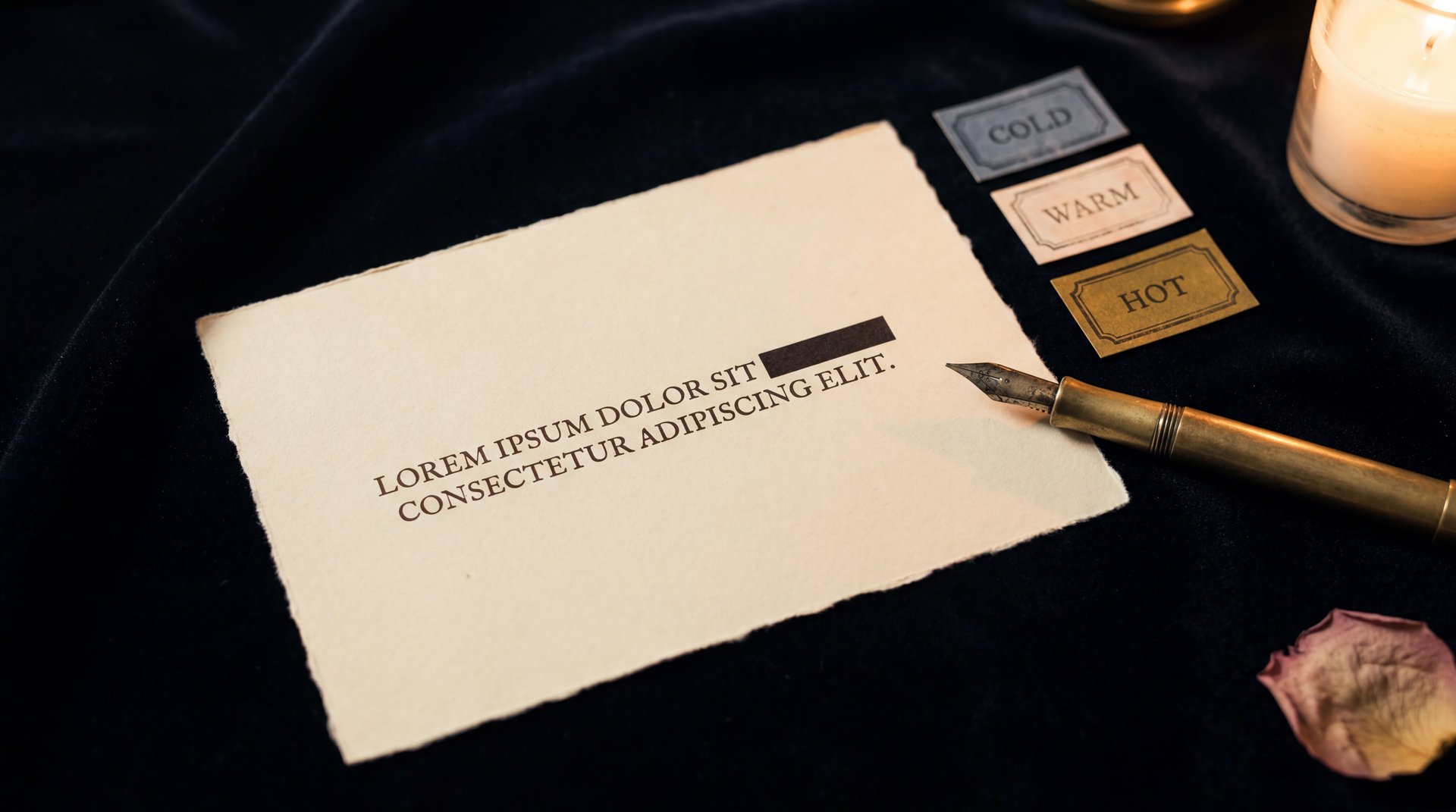
When we sat down to build a game called Hot & Cold for couples, there were two ways to interpret the name. The first was the obvious one — the version everyone played as a child. One partner hides a prize somewhere in the room, the other searches for it, and the hider calls "colder, warmer, hot, hot, you're on fire" as the seeker moves around. The second was less obvious. The partner who knows sees a full sentence on their phone. The partner who's guessing sees the same sentence with one word hidden behind ****. They type a guess; the feedback comes back as cold, warm, or hot based on how close they are to the missing word. Solve the puzzle, the action gets done. We chose the second one. This article is about why.
Why the obvious version would have failed
The treasure-hunt format reads well in a one-paragraph pitch. It dies the moment you actually try to ship it. We worked through the failure modes early and the list got long fast.
It requires physical space. Most couples we know play these games in bed, on a couch, in a hotel room — places where there isn't really anywhere meaningful to "hide" anything. A treasure hunt needs a room. The Wordle-style version works lying down, sitting up, on two phones in two countries. It scales with where you actually are.
It breaks the partner-sync model. When one of you is searching and the other is calling out hot/cold, only one of you is engaging with the device. The other person is the device. That asymmetry kills the dynamic we wanted — both partners holding something interesting at the same time. With the word game, both partners are on their phones, in sync, in the same moment.
Five minutes and the novelty's gone. A treasure-hunt round ends when the prize gets found. That's it. Even with elaborate hiding spots, you're looking at three to five minutes before the round resets — and the room only has so many hiding places before the second round becomes a repeat of the first.
The deck is the prize, and the prize is small. In a treasure hunt, the only "content" is whatever you hide. You can't ship 400 prizes to a couple; you ship a game and they supply the object. That makes the deck shallow by design. The LovePlay model is the opposite: the deck is the game. We wanted a format that could hold hundreds of distinct prompts and shuffle through them without getting stale. The hide-and-seek frame couldn't carry that weight.
The Wordle insight
In 2022, Wordle quietly rewired how millions of people thought about word puzzles. The mechanic is almost insultingly simple — one hidden word, three colored feedback states, low cost per guess — but the loop is addictive in a way no crossword had been for the same audience. We're not the first product team to notice. We are, as far as we know, the first to translate it cleanly into a sex-game context.
Here's why it transferred. In Wordle, the hidden word is just a word — it has no further meaning. In Hot & Cold, the hidden word is the action. The sentence is a sex prompt with one verb or body part masked: "Lick her ****." "Kiss your partner's ****." "Bite his ****." Each guess does two things at once. It moves you closer to solving the puzzle, and it slowly teaches the guesser what's about to happen. That teaching is the part that makes the format work. The partner who already sees the full sentence is holding anticipation. The partner guessing is holding curiosity. Both feel something the whole way through — not just at the climax, when the puzzle gets solved and the action happens. That asymmetric tension is the whole design.
There's a smaller but related point about cost-per-guess. Wordle gives you six tries; the cost of being wrong is just one of those tries gone. We kept the cost low for the same reason — three feedback states (cold, warm, hot), no penalty, no failure mode. The guesser keeps going until they get it. The puzzle is never failed; it's just unsolved for a few more seconds. That low-stakes loop is what lets couples relax into the game instead of bracing against it.
Four intensity tiers — design notes on what each one means
The deck ships in four tiers, and the tier system did more design work than any other single choice we made.
Level 1: tender. Kissing, light touch, light bites, hand-holding-with-intent. No nudity, no genital references, no sex acts. Around 110 prompts. This tier is for couples who haven't done a sex game before, or for the first ten minutes of any session — the warm-up.
Level 2: spicy. Undressing, oral teasing, kissing across the body, light dirty talk. Around 110 prompts. This is where most couples actually live. Playtests showed the middle tiers got picked roughly twice as often as the edges — couples don't want to start at 1 or live at 4. They want a comfortable Level 2 with the option to dial up.
Level 3: explicit. Direct sex commands written in kissable language. Around 90 prompts. The verbs are explicit; the wording stays warm rather than clinical. This is the tier the deck escalates toward when a session has been running for thirty or forty minutes and both partners have warmed up.
Level 4: hardcore. Advanced play, partner-led intimate stimulation, specific positions, the heavier corners of the deck. Around 90 prompts. We deliberately gave this tier the smallest count not because we ran out of ideas, but because the further into this register you go, the more couple-specific it gets — and writing universal hardcore prompts is harder than writing universal tender ones. Beyond Level 4, custom mode picks up the work.
The total comes to 400+ prompts. We wrote that many because Wordle-style guessing burns through content faster than card-draw — every prompt is "used" once you've seen it, and the surprise can't repeat. Volume is the only protection against repetition.
Why the deck has three voices — male target, female target, shared
This was the cleanest design choice we made, and the one we're most quietly proud of. Most couples-game corpora on the web write neutral prompts: "Lick your partner." "Touch your partner." The problem is that "your partner" is ambiguous about anatomy — the guesser doesn't know what specifically is being asked. Worse, the dodge produces flat language. "Lick your partner's neck" is fine. "Lick your partner's area" is not, and that's where neutral writing tends to end up.
So we wrote every prompt three times. Male-target: "Lick his cock." Female-target: "Lick her clit." Shared: "Lick your partner's neck." Same act, different specificity, different anatomy. When you set up a round, you tell the game who's doing what — and it serves the variant that fits. Straight couples see one mix. Same-sex couples see another. Anatomy-neutral prompts (necks, ears, mouths, hands, backs) come through the shared voice regardless of who is at the table.
The result is language that's specific without being clinical, explicit without being awkward. There are no "their what?" moments — the guesser knows roughly what region of the sentence the blank is in, and the resolved sentence reads like something an actual person would say, not a deflection.
Custom mode — the user-authored layer
Four hundred prompts is enough that most couples will never exhaust the built-in deck. A few will, and a few more will want to write their own from day one. So we shipped custom mode: type a full sentence, tap to pick which word becomes the blank, save it to your deck.
We didn't open authoring because we ran out of ideas. We opened it because the mechanic is more interesting when the blank is something the partner wouldn't otherwise have thought of. An inside joke. A callback to a past trip. A word that only the two of you would associate with a specific memory. The Wordle insight transfers here too: the harder-to-guess the word, the longer the build, and the build is the part that matters. When the deck is your own writing, the build becomes intimate in a way pre-written content can't be. The platform supplies the engine; the couple supplies the meaning.
What changed after playtesting
Three things shifted between the prototype and the version we shipped. Each came from watching real couples play, not from data dashboards.
Prompts got shorter. The first version averaged around 60 characters per prompt. Guessers were giving up before the third try — the cognitive load of holding a long masked sentence in mind while generating word candidates was too high. We cut the average to about 40 characters and added a soft cap. Solve rates went up immediately.
We added the skip button. Playtests showed couples wanted an out — not for the whole game, just for a specific prompt that didn't land. We added skip with no penalty, and couples used it on roughly one in eight cards. That's healthy. A locked-in deck is a brittle one.
The feedback got faster. The first build had a one-second delay between submitting a guess and seeing the cold/warm/hot result. We'd added it "for drama." Playtest after playtest, the same note: it felt like loading, not anticipation. We pulled the delay out. Feedback now fires instantly, and the format suddenly felt like a game instead of a form.
If you've read this far, you can set up a Hot & Cold round in about a minute. The deck is ready, the tiers are set, the three voices are wired up. The rest is between you and your partner. For a wider tour of what we've built around it, our ranked guide to the games library covers all ten current titles, and the daily sex calendar guide is a longer read on the editorial side of the same product.
Frequently asked questions
Because the hide-and-seek format fails as a couples sex game for four reasons we ran into immediately: it needs physical space (most people play in bed), one partner has to be moving and the other stationary (kills the partner-sync we wanted), it burns through novelty inside five minutes, and the deck of hideable prizes is small. The Wordle-style version keeps both partners on screen, on the same beat, and lets us ship 400+ prompts that the game can shuffle through over months of play.
The mechanic is borrowed — one hidden word, three feedback states (cold/warm/hot), low cost per guess. The content is entirely sex-context: every prompt is an explicit instruction, the guesser is your partner not a stranger, and solving the puzzle triggers the action the sentence describes. Wordle is a solo game with a shared answer; Hot & Cold is a two-player game with private content and a physical payoff.
Every prompt is written in three voices — male-target, female-target, and shared. The game shows the variant that matches who is doing what. Straight couples see one set, same-sex couples see another, and the shared voice covers anything anatomy-neutral (necks, ears, hands, mouths). If a specific prompt still doesn't fit you, the custom mode lets you rewrite it in your own language and pick which word becomes the blank.
Yes, and the design works better long-distance than most card-draw games. One phone shows the full sentence (your partner reads it and watches you guess), the other shows the masked version with **** in place of the hidden word. You type guesses; feedback fires on both screens in real time. The action itself becomes whatever you negotiate — voice, video, or saved for the next time you're together.
The shared voice already covers most of the deck — any prompt that doesn't depend on specific anatomy is written gender-neutrally. We didn't build a fourth dedicated voice on launch because the existing three (with shared as a fallback) cover the vast majority of prompts cleanly. If demand from non-binary couples justifies a dedicated voice with its own anatomy options and language, we'll add it — the deck is already structured to accept a fourth variant.
Try it tonight
The shortest way to evaluate any design is to use the thing. Open the setup, pick a tier (Level 2 if you're new to it), agree on who's doing what, and run five prompts. You'll know inside ten minutes whether the format clicks for you — and if it does, the deck has another three hundred and ninety-five waiting. For the wider picture of how Hot & Cold sits next to our other titles, walk through the best couples games of 2026, or if board-mechanic puzzles are your thing, the Tic-Tac-Wishes deep guide is the closest sibling piece. The full catalogue lives in our full games library.